Joe Zammit-Lucia is a RADIX Co-Founder and board member. He is an entrepreneur and commentator on business and political issues writing in outlets in the UK, US, Germany and the Netherlands. His particular interest is the relationship between business and politics.
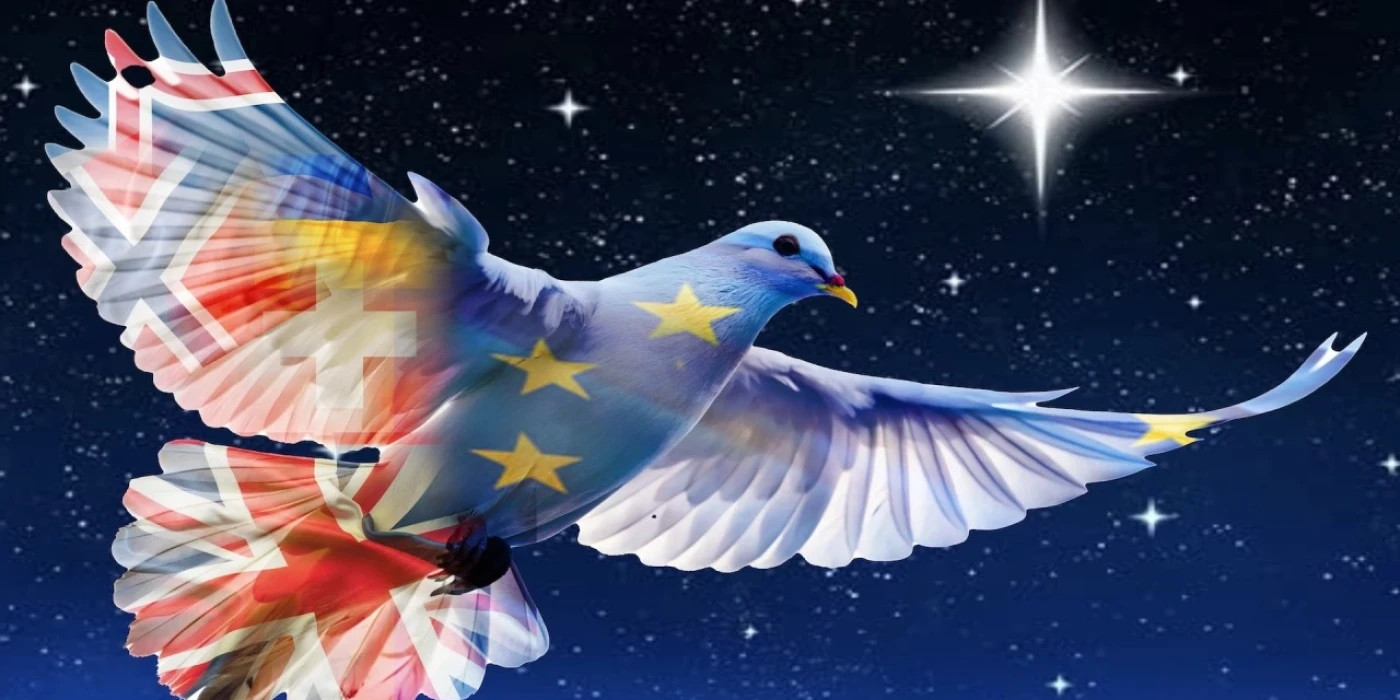
Can Europe spread its wings and fly?
This is Europe’s moment. Is it capable of seizing it?
The international order that many of us have been used to is over. And the past never comes back. The current US administration has decided to re-cast its global leadership role and the relative global stability of thepax americana.
No other democracy has the heft and power to replace the United States to maintain and enforce a global order. Yet, as we head into an unknowable future, many would like to see key elements preserved - if modified. Democratic norms, the societal stability and commercial predictability provided by respect for the rule of law, space for cross-national collaboration as well as competition (what we used to call ‘co-petition’), the principle that borders will not be changed by force, and much more.
Europe, including the European Union (EU), is one area where such principles remain alive and more-or-less respected. Can this be Europe’s moment? Can Europe seize the opportunity to become the hub of a broad coalition of nations that wish to re-cast the global order for the realities of a 21st century world rather than either abandoning it completely or trying to hang on to an obsolescent past?
What is not possible
Let us start with the realism of what is unlikely to be possible.
Europe and much of the democratic world is not in a position to look after its own defence and security without American partnership and collaboration. We have left ourselves not exactly naked but certainly nowhere near adequately clothed through nearly a century of utter negligence by European governments of all colours that seem to have forgotten that ensuring the security of their citizens is the number one priority for any government.
European leadership only has itself to blame. In 1949, Secretary of State Dean Acheson and, in 1953, US President Eisenhower both urged Europe to take responsibility for its own defence and security. Such encouragements were repeated by George W Bush and Barack Obama. To no avail. It took the return of war in Europe and brutish Trumpian tactics for our governments finally to show tentative signs of life.
Whether, when faced with the difficult real-world trade-offs, these tentative signs of life will translate to sufficient action remains to be seen. In a recentFT column, Janan Ganesh argues that‘Trump offers the continent just enough support to induce a level of complacency but not enough to make the place safe against its enemies…These twinkles of hope are precious but also an excuse for Europe to soft-pedal its transition towards being able to look after itself.’
The comfort of being able to suckle at the American breast while indulging in the electoral enticements of spending our own money on ever ballooning welfare expenditure; the undeniable fact that US defence and security technology is, in most areas, largely superior to any other; the reality that our intelligence, security and defence capabilities are inextricably intertwined, and dependent on, US collaboration. All this means that the much vaunted ‘strategic autonomy’ will be at least a generation in the making - if it is indeed possible.
Nato secretary general Mark Rutte put it bluntly:“If anyone thinks that the European Union, or Europe as a whole, can defend itself without the US, keep on dreaming. You can’t. We can’t.”
This reality should give pause to those who, irresponsibly, press for an abrupt transatlantic rupture. The nature of that partnership will change but, despite the difficulties, it must continue to be nurtured as best possible. The alternative is Europe as a sitting duck.
Europe as collaborative hub
Despite its relative weakness in hard power, Europe remains a significant geopolitical player. It has four of the G7 economies. Two permanent seats on the UN Security Council. It represents a large and wealthy economic bloc. European countries have long-standing, well established diplomatic capabilities across the globe.
At the centre of all this lies the EU – a massive, and by-and-large successful, experiment in trans-national collaboration the like of which has never been seen. For Europe to succeed as a collaborative hub in a changing world, the EU has to be at the centre of the action.
Yet, to do so, the EU itself will have to change. Significantly. It will need changes in attitude, in its internal workings and in its willingness to engage better and more easily with non-EU friends and allies.
Attitude
First is attitude. Europe must evolve beyond its embedded risk aversion. This affects both investor and institutional attitude to risk. The precautionary principle has resulted in a continent mired in endless regulation that soon risks making economic activity all but impossible – and certainly uncompetitive. To take just one example among many, the EU’s AI Act approaches new technology primarily as a threat to be guarded against rather than as an economic opportunity to be seized.
As a friend once put it to me, the only way to ensure a helicopter is one hundred percent safe is to make sure it never leaves the ground. Not getting off the ground might be the fate of European economies if safety first continues to be taken too far. And without thriving, growing economies Europe has no geopolitical power and no funds to defend itself.
Fortunately, the European Commission has embarked on a significant de-regulatory drive. Let’s see how far that goes. Through omnibus legislation it is also trying to overcome the slow, ponderous, Byzantine and ultimately uncompetitive decision-making processes that hold it back. Some haveexpressed concernthat the omnibus approach is a controversial and opaque mechanism that will create more uncertainty and undermine democratic accountability. Maybe. Maybe not. But in today’s and tomorrow’s world the idea that Europe’s power lies in being the global regulatory standard setter is shown up as being the nonsense it always was.
Europe seems to have forgotten the words of Ludwig Erhardt, the German chancellor who presided over what we have come to call the post war German economic miracle. In his 1958 book, 'Prosperity through Competition', he wrote:“What has taken place in Germany . . . is anything but a miracle. It is the result of the honest efforts of a whole people who, in keeping with the principles of liberty, were given the opportunity of using personal initiative and human energy.”
Internal Workings
As the EU grows and plans to continue to admit more members, the approach that requires all Member States to move in unison is doomed to failure. Some argue that this is best resolved by abolishing the need for unanimity in all areas where that still applies. This is typical of the centralising technocratic perspective that seems to prefer control over liberty while ignoring both emotional impact and political realities. Countries that feel press-ganged into adopting positions that local citizens and their elected representatives do not support is a sure way of building resentment and the emergence of fissures that will be hard to heal.
Much more effective would be the further encouragement of a more flexible architecture. One where coalitions of the willing can embark on initiatives that suit them while allowing opt-outs for those that do not wish to be part of such initiatives. This creates the much-needed delicate dance between cooperation and competition among Member States rather than the ineffective and initiative-sapping illusion that competition between Member States should, and can, be eliminated. Flexible architecture will likely encourage more Member States to collaborate willingly for fear of missing out. Nobody needs to feel forced to do that which they do not wish to do. EU membership will become much more appealing, and the bloc can move faster and better.
There are some tentative signs that the bloc is slowly moving in this direction. It needs to go further and faster. Much faster.
Broader engagement
Finally,the EU needs to make it easier and smoother for third countries to engage with it.
Currently, and despite its unconvincing contention of being an open economy, the EU has built around itself bureaucratic and legalistic walls that make it a nightmare for third countries to deal with it. The preference remains for collaborative projects (and expenditures) to be confined to its own Member States. Third countries wishing to collaborate face enormous hurdles.
This is no way to project power and influence.
If the EU wishes to become the hub of a newly evolving world order, it must fling open its doors to widespread alliances and collaborations. With the UK, Switzerland, Norway, Canada, Australia, New Zealand, S Korea, Japan, India, some in Latin America, and many others who share enough of its values and are also looking for a refreshed global architecture. Collaboration that is not limited to celebrating traditional trade deals, that, in themselves, will become ever-less economically valuable as economies shift towards non-tradable services, but one that goes much deeper.
We have evidence that this is not only possible but effective.
The Franco-British led coalition of the willing in defence and security matters seems to be working reasonably well. The Italy, UK, Japan Global Combat Air Programme is running as well as one can hope such complex programmes to run. And seemingly better than the competing Future Combat Air System between France, Germany and Spain where ongoing disagreements may result inno fighter jet at all, with Germany reportedly considering jumping ship from one to the other.
Looking at the world through a broader lens, Europe can also use existing institutions to spread its influence further. Organisations such as the Francophonie and the Commonwealth can provide Europe with an established conduit to African, Caribbean and other states.
In other words, the EU needs to embrace “the European spirit of openness and cooperation” that the European Central Bank claims to have inspired the original design of the Euro banknotes. A sprit that needs to be embodied in the EU’s attitude, actions, lived reality and external relationships not just in words.
Doing all this will require the EU to lift its eyes from contemplating its own navel to look outwards, avoid tying itself in knots before anything can be agreed (or taking 25 years to finalise deals with other blocs like the Mercosur), starting to believe that it does have sufficient heft, economic and soft power, and the widespread international networks that allow it to have a significant role in shaping our global future.
Success will also depend on an EU that approaches its allies and partners as equals in the spirit ofreciprocity, not one that tries to throw its weight around, Trumplike, as the chest-thumping big beast in the ring – a sure way of getting nowhere. It must take to heart the idea that you catch more flies with honey than with vinegar.
The future of Europe and of whatever global order will emerge depends on many nations spread across the globe. The power and influence of the United States will not disappear overnight - if at all. It needs to be held close despite the challenges. But it is time that the EU gets past obsessing about its own petty rules and develops the self-confidence to lead with humility and a much broader perspective than its own self and its immediate neighbourhood.
This blog was first posted on Joe's Random Thoughts newsletter on LinkedIn.
Rate this post
Leave a comment
Please login or register to leave a comment on this post.