He has spent most of his career in business; for many years he ran the Strategy practice at PA Consulting Group. During this time, he began to explore whether the tools and techniques of business strategy could be applied to understanding the health and stability of countries. This research led him to the uncomfortable conclusion that many developed countries – including the US and the UK – are unwittingly pursuing economic policies which will result in the unwinding of 20th century civilisation before we reach the year 2050. Hearteningly, he also concluded that this fate is entirely avoidable.
Mark has a degree in Mathematics from Cambridge University.
Should we care about healthcare privatisation?
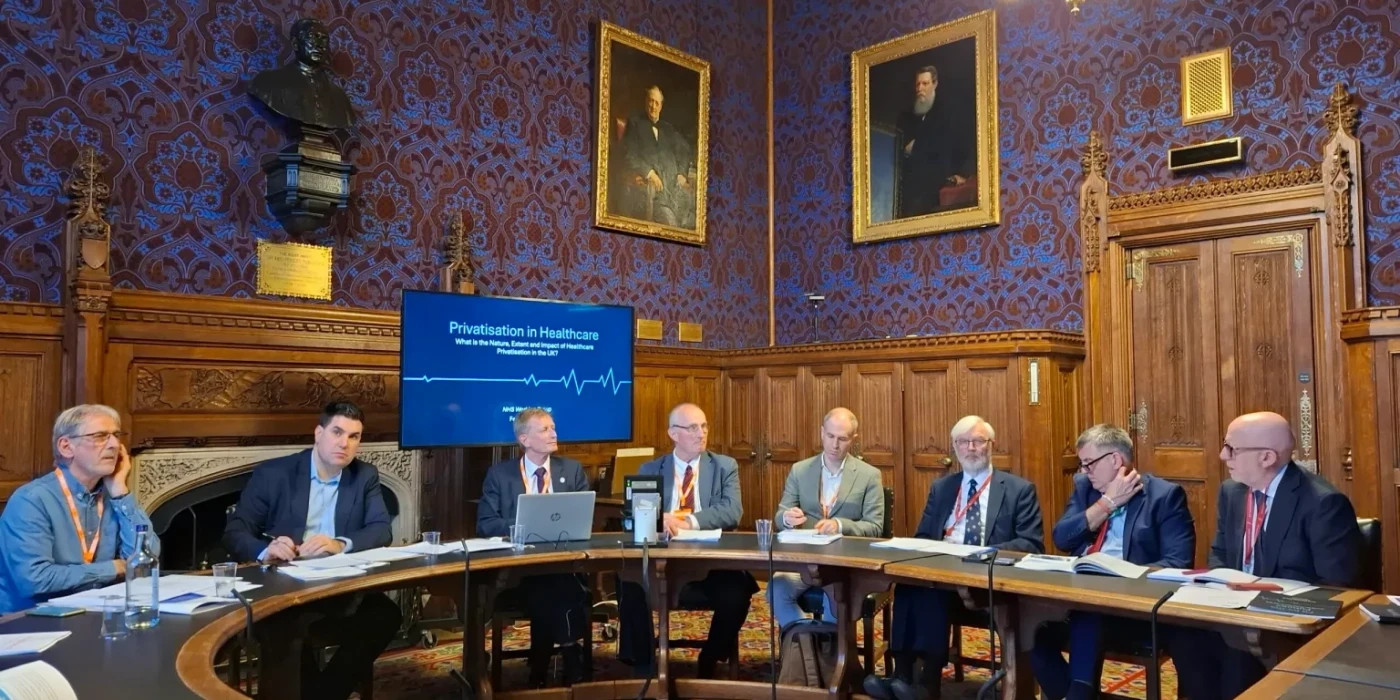
This is an approximate transcript of the meeting in Parliament on 24 February 2026 of theWorking Group on the NHS, chaired by Richard Burgon. It was attended by MPs and members of the House of Lords, and by invited guests.
Good afternoon and thank you for coming to today’s event, which is the second meeting of the Working Group on the NHS.
The first meeting took a big-picture view of the government’s plans for the NHS and showed how we can still restore it to its former glory – little over a decade ago, the NHS was ranked as, overall, the best healthcare system in the developed world. In short, we should learn from what the last Labour government gotright, andavoid what it got wrong.
One of the things it got wrong was increasing the role of the private sector in provision of NHS services.
Today’s session will explore how serious a mistake it would be to repeat that error. I am particularly concerned about PFI (the Private Finance Initiative) which was found to be so costly last time, and which appears to be reappearing as part of the 10-year plan.
We have a very strong expert panel today to help us explore the whole issue of healthcare privatisation.
Mark Dayanis a Policy Analyst and Head of Public Affairs at the Nuffield Trust, an independent think tank with no party affiliation. He has also been involved in monitoring of the private sector.
Colin Hutchinsonis a former NHS Consultant Ophthalmologist. He was Chair of Doctors for the NHS from 2017 until recently. He has been a Labour Councillor in Calderdale for the last 7 years.
Tony O’Sullivanis a former NHS Consultant Paediatrician. He has served as Co-Chair of Keep Our NHS Public since December 2015, and he was a founder member of Campaign for the NHS Reinstatement Bill from June 2014.
Mark E Thomasis the Founder of the 99% Organisation. His book99%: Mass Impoverishment and How We Can End Itwas one of the FT’s Best Books of 2019, and he is also the lead author of the working paper.
As well as the panel, there are quite a few other experts in the audience, who I am sure we will hear from later.
The bulk of the session will consist of an opportunity for you to ask questions of the expert panel, but before that I will ask Mark to give you a quick summary of the working paper.
Summary of the Working Paper
Thank you, Richard. And good afternoon, everyone. Thank you for coming.
As Richard said, before we get to question and answers with the expert panel, I am going quickly to summarise why we believe that privatisation is afar more important policy issue than the government acknowledges.
At ourlast session, we looked at what it would take to get the performance of the NHS back to its former position in the early 2010s as the best healthcare system according to international benchmarks.
Our conclusion was simple: the government should learn from what the last labour government gotrightbutavoid the mistakesthat that government made – there is less room for error now.
One particular mistake that last government made was to encourage increasing privatisation, and that is the focus of this session.
But do we really need to we worry?Successive governments have repeatedly told us that the NHS is not being privatised and will never be, that any private sector involvement is at a low level and is not rising, and that in any case it’s only ideological opponents of the private sector who care about it –patientsdon’t mind who treats them.
So in this session, we’re going to examine those three points:
What is healthcare privatisation?
How much is there really?
Does it matter – in particular, does it matter to patients?
What is healthcare privatisation?
The last Conservative government used to deny that there had been any privatisation using the carefully-crafted phrase,“the NHS is not, and never will be, for sale under any Conservative government.”This government says that the NHS will always remain free at the point of use.
The World Health Organisation has a simple definition, that privatisation is any process which increases the involvement of the private sector in the financing or delivery of healthcare services.
So that is three different definitions.Which definition is more reasonable?Well, if the NHS were reduced to, say, 10% of the UK healthcare landscape – e.g. through continued underfunding – leaving 90% to the private sector, that wouldnotbe selling it off, and what was left of the NHS could still be free at the point of use, butthe NHS as we know it would be gone… and thatwouldbe captured by the WHO definition.
In fact, there are at least 5 ways of privatising the NHS, only one of which involves selling it off in whole or in part:
The most common iscontracting-out: using public funding to pay private companies to deliver NHS services;
If the NHS starts charging for services, rations them or withdraws them completely, then patients can besqueezed outor eventhrown outof the NHS and forced either to go without treatment or to pay privately;
Another common way of involving the private sector is by thePrivate Finance Initiative(PFI) which replaces public borrowing with inevitably more expensive private sector finance;
The most subtle way of involving the private sector is by giving private sector organisations a role in thegovernance or managementof the NHS;
And finally, itwouldbe possible tosell-offparts of the NHS, but this has rarely happened.
We will come back to look at the impact on patients of these approaches on the patient and the taxpayer, but first we should deal with thesecondassertion thatif there is any privatisation of these forms it’s at a low level and not increasing, so we do not need to worry about it.
How much privatisation is there really?
The most widely-cited figure suggests that privatisation is running at about 7% of the total and is broadly static – in other words, it’s a minor issue in the grand scheme of things. But that 7% represents only a tiny part of the picture: it does not even fully capture the impact of contracting-out and it doesn’t measure the impact of being squeezed out or thrown out at all.
Once we correct for those errors we get a very different picture.
And notice that even in our corrected version, we are if anything understating the case: technically GP practices are private sector organisations but we are treating them as part of the NHS because they are not usually corporate entities and most of them have seen themselves as part of the NHS (rather than as profit-maximising entities) and they are generally seen that way by patients.
The corrected picture shows that we’re already at the point where 20% of healthcare delivered in the UK ispaid for privately– either by patients paying directly out of their own pockets or indirectly via private insurance. In addition some of what is paid for by the NHS isdeliveredprivately so the total percentage of healthcaredeliveredby the private sector is now over 30% and continuing to rise. In some specialties that figure is already over 50%.
The idea that NHS privatisation is a small issue that policy makers do not need to worry about is clearly false. If you want to have a figure in your mind, forget the claim that it’s around 7% andremember that it’s around 30% and rising.
And this brings us to the final, and most important question: does it matter – in particular,does it matter to patients?
Does it matter?
Ophthalmology
One area where there has been extensive contracting-out is Ophthalmology, in particular cataract operations.
Many cataract operations are relatively simple procedures which can be performed very quickly. A number of private sector organisations, known as ‘cataract factories,’ have been set up to specialise in delivery of simple cataract operations. If the only goal of policy were to reduce waiting lists, regardless of medical outcomes, this would not be concerning. But that shouldnotbe the only goal.
Medically, using a consultant’s time for early removal of a cataract has little or no benefit – though itishighly profitable – because such cataracts often have no impact on a patient’s day-to-day life. But unlike mild cataracts, there are other conditions such as glaucoma and macular generation which, if not treated swiftly, can result in permanent blindness. The president of the Royal College of Ophthalmologists described the result of the extensive use of cataract factories as patients with very mild cataracts“getting surgery at the expense of other patients going blind.”
This brings us back to the assertion that ‘patients don’t mind’ who provides their healthcare services. The patient who gets the early cataract operation certainlydoesn’tmind: they feel they have been treated quickly and efficiently. But the patient who goes needlessly blind, if they knew the reason for the delay in their treatment, would behorrified.
There are other reasons, to do with the sustainability of NHS provision, why we should be concerned about the extent of contracting out of Ophthalmology, but the impact on patients is the one I wanted to highlight.
Dentistry
Inprinciple, dentistry is still available on the NHS, but in practice, many parts of the country have become ‘dental deserts’ where it is almost impossible to find an NHS dentist. Nationally, certain treatments – especially fillings, which are ‘Band 2’ in the chart – have virtually disappeared from NHS dentistry. Patients have effectively been squeezed-out of the NHS and forced to rely on private provision, or worse.
Of course, the patients who suffer most from this are the poorest. The British Dental Association reported that the vast majority of dentists have now seen patients who have been attempting do-it-yourself dentistry.
Of course, this also matters enormously to patients.
Hip replacements
Joint replacements are another area where private provision has become widespread. This is usually reported as patients“opting to go private”to avoid long waiting lists, and that is bad enough. But some patients are beingthrown out: they do not even have the option to wait.
Although NICE, the National Institute for health and Care Excellence, guidelines state that issues such as smoking and obesity shouldnotbe barriers to referral, almost half of all CCG’s had a body mass index policy in place which meant that obese patients were not eligible.
Similar issues apply to provision of hearing aids and procedures like earwax removal and varicose veins.
In all these examples, patients have suffered directly.
Private Finance
In the case of private finance, it is thepublic pursewhich suffers directly.
There’s no question that the public sector can always borrow more cheaply than the private sector, and therefore in general the Treasury discourages the use of private finance. But the last Labour government, order toappearnot to be borrowing, made extensive use of private finance.
This was justified on a promise that although the finance itself would be more expensive, by bundling together with finance, construction and operation costs, which the private sector would do more efficiently than the public sector, overall, PFI would give good value for money.
In reality, as the National Audit Office and the Public Accounts Committee both found, PFI didnotgive good value for money: the cost of construction was not lower – to prevent overruns, the private sector simply built in the contingency into the cost, and nor was the cost of operations: the only saving made was through the reduction in terms and conditions of employees, and this accrued to the private sector.
Because the contracts were extremely long term – many decades long – it was impossible to predict precisely what the requirements would be in future, and the private sector made extensive use of change-control provisions which meant that from the taxpayers’ point of view trivial changes like moving a power socket became exorbitantly expensive.
PFI 1 and PFI 2 were both found to suffer from these problems. The government denies that it is using PFI, claiming instead to be ‘adopting the Welsh model’ – but this in itself is simply another form of PFI, we could call it PFI 3, and it will inevitably present most of the same drawbacks.
Governance and management
The final issue, and perhaps the subtlest, is involvement of private sector providers in NHS governance.
Quite rightly, we expect the NHS to focus primarily on quality of patient care and value for money for the taxpayer. We are happy that providers to the NHS make reasonable profits, but we would not want to steer the NHS to maximise those profits.
Corporate providers are legally obliged to take a different view. Under both the US and the UK Companies Acts, directors have a fiduciary duty to the members of the company – i.e. to the shareholders. This means that they must put profits first and patient care and value for money to taxpayers become secondary considerations. This means they are legally bound to focus on providing only the services which are profitable, to patients who are profitable, in regions which are profitable.
In 2015, Circle Health withdrew from managing Hinchingbrooke Hospital because, it was“no longer [financially] viable under current terms.”And in 2023, Centene withdrew from providing GP services in London services when it found it was not making a profit. Similarly, treating simple cataracts is profitable; treating macular degeneration is not.
When the private sector withdraws like this, either the NHS must step-in or the health of the population collapses.
The private sector views UK healthcare as an enormous profit opportunity, and sees the NHS as a competitor in serving that market.
No private sector organisation would allow its competitors to play a role in its governance: alignment of interests is well understood as a central principle of organisation design.
That principle is something that policy-makers could learn from the private sector.
Conclusion
We have debunked three myths:
There is no privatisation of the NHS, and there never will be – simply not true;
If there is any, it is a low level and it is not increasing – simply not true;
In any case, patients benefit from privatisation – simply not true.
This is somethingpolicymakers urgently need to understand: current policy endangers patients, harms public finances and undermines the NHS itself.
Thank you. I’m sure you’ve all got lots of questions.
There followed around 40 minutes of discussion, which unfortunately we were not able to record.