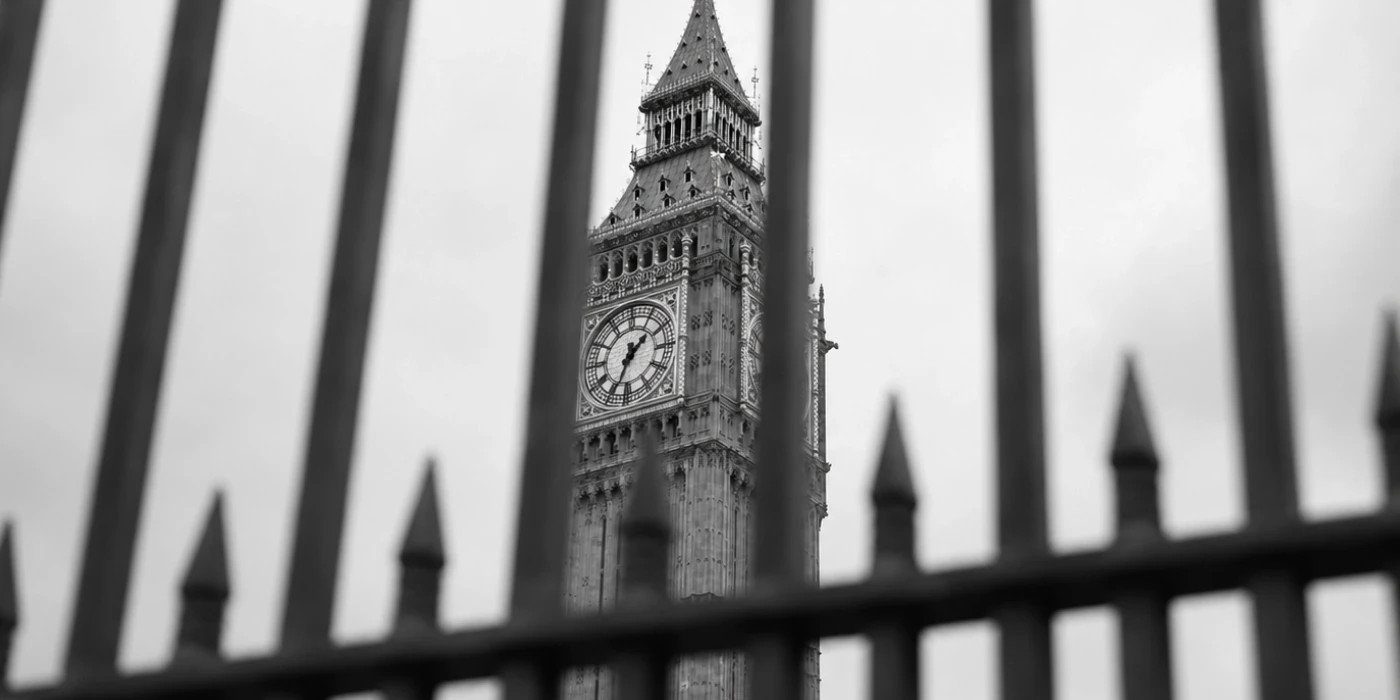
One of the unexpected consequences of spending two years in Parliament is that Westminster gradually stops feeling like Westminster.
Like most people, I'd visited before I was elected. I'd admired the architecture, wandered through Westminster Hall, watched debates from the public gallery and experienced the peculiar sense that this was a place somehow separate from ordinary working life. Then, almost imperceptibly, it became somewhere I happened to work. I acquired an office, a parliamentary pass, somewhere to leave my coat and a desk on which papers accumulated in precisely the same way they had in every other organisation I'd worked in. The symbolism never entirely disappears, but it recedes just enough to reveal something else: Parliament is, among many other things, an organisation.
Two years ago, not long after arriving, I wrote that Westminster struck me as an organisation ripe for transformation. At the time I assumed that observation was really about Parliament. Looking back, I think it was about something much broader. Parliament simply happened to be the first institution through which I was seeing a pattern that now seems to emerge almost everywhere I look.
Before entering politics I spent much of my career helping organisations adapt to technological change. Looking back, I suspect that experience left me with a habit of mind that has proved rather difficult to shake. I rarely find myself asking whether an organisation is successful or unsuccessful. Instead, I become curious about why it is organised in the way that it is. Why does a particular process exist? What problem was it originally intended to solve? Why does responsibility sit here rather than somewhere else? At what point did this become accepted as the normal way of doing things? After a while, organisations cease to look like collections of departments and hierarchies and start to resemble the accumulated result of thousands of design decisions, each made by sensible people responding to the circumstances of their own time.
Westminster is fascinating precisely because those layers are unusually visible. Parliamentary procedure, committee structures, conventions, reporting lines and constitutional arrangements have accumulated over centuries rather than decades. You can almost see successive generations responding to new challenges by adding another mechanism, another safeguard or another exception. None of those individual decisions is irrational. Most were probably entirely sensible. Yet viewed together they create an organisation of extraordinary complexity, in which today's participants often spend as much energy navigating inherited structures as they do pursuing the purposes those structures were originally intended to serve. It's ended up becoming a problem of our own making.
But the more time I spend outside Westminster, however, the more I realise that Parliament is not exceptional. If anything, it is unusually honest. Its age makes visible something that is true of almost every institution.
Spend a week moving between Parliament, a district council, an NHS trust, a technology company, a manufacturing business and a university, and the conversations begin to sound remarkably similar. People talk about decisions taking longer than anyone would choose, about information scattered across multiple systems, about teams working hard but not always together, about processes that everyone acknowledges are frustrating but nobody feels able to change because each one appears connected to ten others. The language differs from sector to sector, but the underlying questions remain strikingly familiar. How do we make better decisions? How do we coordinate more effectively? How do we adapt to changing circumstances without losing the stability that institutions exist to provide?
That observation has gradually changed the way I think about Britain's challenges more generally. Public debate often encourages us to believe that our principal problems arise from a shortage of good ideas, capable people or political will. My own experience increasingly points in another direction. Week after week I encounter extraordinary people doing remarkable things. Entrepreneurs continue to build ambitious businesses, researchers push the boundaries of scientific knowledge, teachers transform young lives, volunteers hold communities together, civil servants wrestle conscientiously with immensely difficult questions and public servants across every sector display a level of commitment that rarely attracts headlines.
What strikes me is not a shortage of talent, but the growing mismatch between the capability of our people and the capability of the systems within which they are expected to operate. That feels like a rather more hopeful diagnosis, because while changing people is difficult, redesigning systems is at least possible.
Artificial intelligence has sharpened this line of thought in unexpected ways. Almost every conference and board meeting now contains some version of the question, "How can AI help us?" It is an entirely sensible place to begin, but I increasingly wonder whether it resembles the first generation of factories that replaced steam engines with electric motors while leaving everything else unchanged. The technology improved immediately; productivity did not. The real transformation came only when manufacturers stopped asking how electricity could improve the existing factory and started asking what a factory designed around electricity might look like in the first place.
I suspect artificial intelligence presents organisations with a similar opportunity. The most significant question is unlikely to be how we make today's processes marginally faster or cheaper, useful though those improvements undoubtedly are. The more interesting question is what assumptions we have stopped noticing because they have become embedded in the design of our institutions. If we were creating them today, knowing what we now know about technology, communication and human behaviour, would we really organise them in quite the same way?
That is not fundamentally a technological question. It is an organisational one.
Indeed, one of the biggest shifts in my own thinking over the past two years has been the realisation that politics is as much about institutional design as it is about policy. Policy rightly occupies much of our attention, but policy rarely operates in isolation. It passes through structures, incentives, cultures and processes that determine whether good intentions become meaningful outcomes. We spend a great deal of time debating what government should do, and perhaps rather less considering how government itself is organised to do it.
None of this should be interpreted as an argument for perpetual disruption. One of Britain's greatest strengths lies in the stability of its institutions. The rule of law, an independent civil service, parliamentary democracy, local government and our universities all provide continuity that many countries rightly envy. Stability is not the enemy of reform; indeed, it is often the condition that makes thoughtful reform possible. The challenge is ensuring that stability does not quietly become inertia.
Perhaps this is why I find myself becoming increasingly interested in the idea of stewardship. Every generation inherits institutions created by its predecessors. Our responsibility is neither to preserve them unchanged nor to dismantle them carelessly, but to understand the problems they were originally designed to solve and to ask, with appropriate humility, whether those remain the problems we most need to address. Good institutions endure because they adapt. The paradox is that preserving their underlying purpose sometimes requires changing their form.
When I arrived in Westminster I imagined that my role would primarily involve contributing to debates about policy. Those debates remain enormously important. Yet I increasingly suspect that one of the defining questions facing Britain over the coming decades is not simply which policies we choose, but whether we can recover the confidence to redesign our institutions thoughtfully around the realities of the world as it is today, rather than the one for which they were originally conceived.
That, perhaps, is the most optimistic conclusion I have reached during my first two years in Parliament. Britain's future does not depend on discovering reserves of talent that somehow do not already exist. They do. Nor does it depend on believing that everything built by previous generations was misguided. Much of it was extraordinarily successful. Our task is something both more modest and more ambitious: to become as thoughtful about redesigning our institutions for the future as our predecessors were about designing them for their own age.
In the end, that may be one of the most important responsibilities of politics. Not simply to argue about the direction in which the country should travel, but to ensure that the vehicle itself is capable of making the journey.
This article is adapted from The Human Advantage: Technology Changes What's Possible. People Decide What Matters, my keynote exploring what business, politics and organisational leadership can learn from one another in an age of artificial intelligence.