Nick Silver is an actuary and economist whose specialities include risk management, social insurance and environmental finance. He is the author of "Finance, Society and Sustainability: How to Make the Financial System Work for the Economy, People and Planet" (2017).
Net Zero No More
The UK’s much maligned net zero policy is that the UK is legally committed to cutting greenhouse gas emissions by at least 100% of 1990 levels by 2050. To some extent it has been a success, emissions are down by more than half since 1990.
However, it has resulted in some unintended consequences, on which its critics have picked up. The UK has some of the most expensive energy in the developed world, both on the bill and in the up-front cost of getting there. We have offshored much of our energy-intensive industry rather than powered it at home, which means global emissions have not reduced as a result of our territorial reductions, and we have remained exposed to global energy shocks. This has allowed cultural warriors to label it “net stupid”, (although I suggest Reform UK should rename themselves Net Stupid Party).
My argument is that we should retire net zero as the organising target for UK energy policy, and replace it with a policy of abundant, cheap, clean energy for the population and industry, resilient to shocks, pursued as a matter of national security. If we can achieve cheaper energy bills, this will be self-perpetuating, generating demand for more clean energy and hence cheaper bills.
Never trust forecasts, especially about the future, but my guess would be that changing in this direction would result in less global emissions than the current net zero framing.
Cheap sun, dear bills
The key to why we should rethink are two puzzles.
When I started working on climate change, electricity from the sun was the most expensive way of generating power that there was. It is now the cheapest (with wind following it down the cost curve). That fact alone should have solved most of our problems; so if renewables are now the cheapest form of generation, why are UK electricity prices so high?
Second: we have lived through a run of energy shocks – Russia’s invasion of Ukraine, the Iran war – while investing heavily in renewables and now getting a large share of our electricity from them. Renewables are intermittent, but even so they should have reduced our exposure to fossil fuel shocks. They evidently haven’t. Why not?
Three reasons, in reverse order of importance
Levies on bills. There are direct and indirect charges on energy bills to pay for the green transition. These have been trimmed but still run to around 6%. These and future costs for green transition should be removed from energy bills and paid for elsewhere.
Electricity is priced off gas. UK wholesale electricity is priced by whichever generator is needed last to meet demand in each half-hour settlement period, and that marginal generator is usually a flexible gas plant. Gas’s cost then gets paid to every generator on the grid – including wind and solar running at a fraction of the price, so bills still track gas prices even as renewable capacity grows. It does not necessarily need to be this way and there have been a number of reform proposals, but there is no easy solution. However, decoupling electricity prices from gas should be one of the main priorities of the Government, and where there’s a will there’s a way.
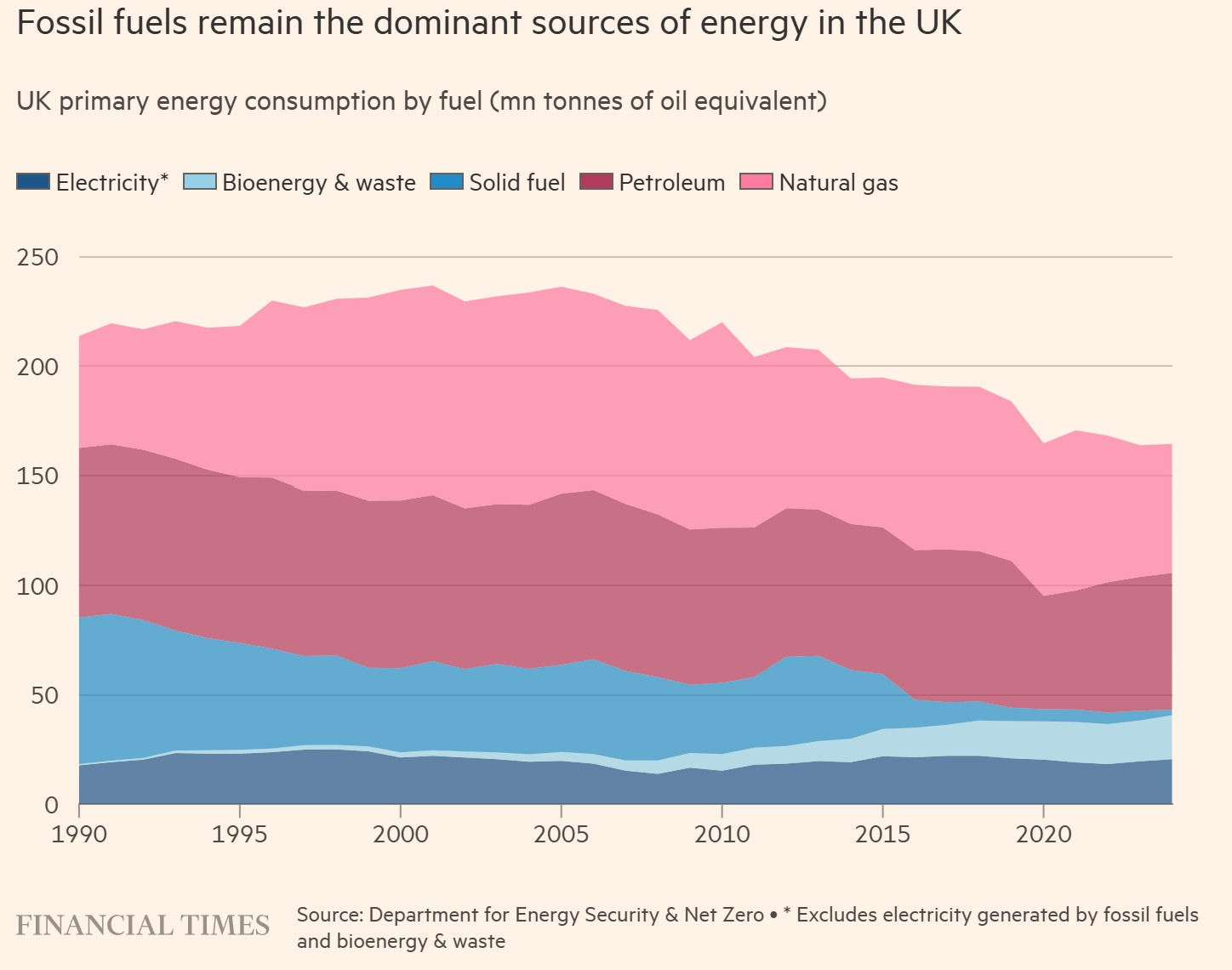
We have not actually reduced our reliance on fossil fuels. The chart below, from the Financial Times, tells a few stories: coal was replaced by gas in electricity generation, with coal essentially gone by the 2010s; more recently, renewables have displaced gas. But the proportion of UK electricity generation that is non-fossil has barely moved over that period – we have simply swapped nuclear for renewables. And electricity is not where most of our fossil fuel use sits. The two big blocks are direct use of natural gas, mostly for heating buildings, and petroleum, mostly for transport.
Chart 1: UK primary energy consumption by fuel, 1990–2024 (Financial Times / DESNZ)
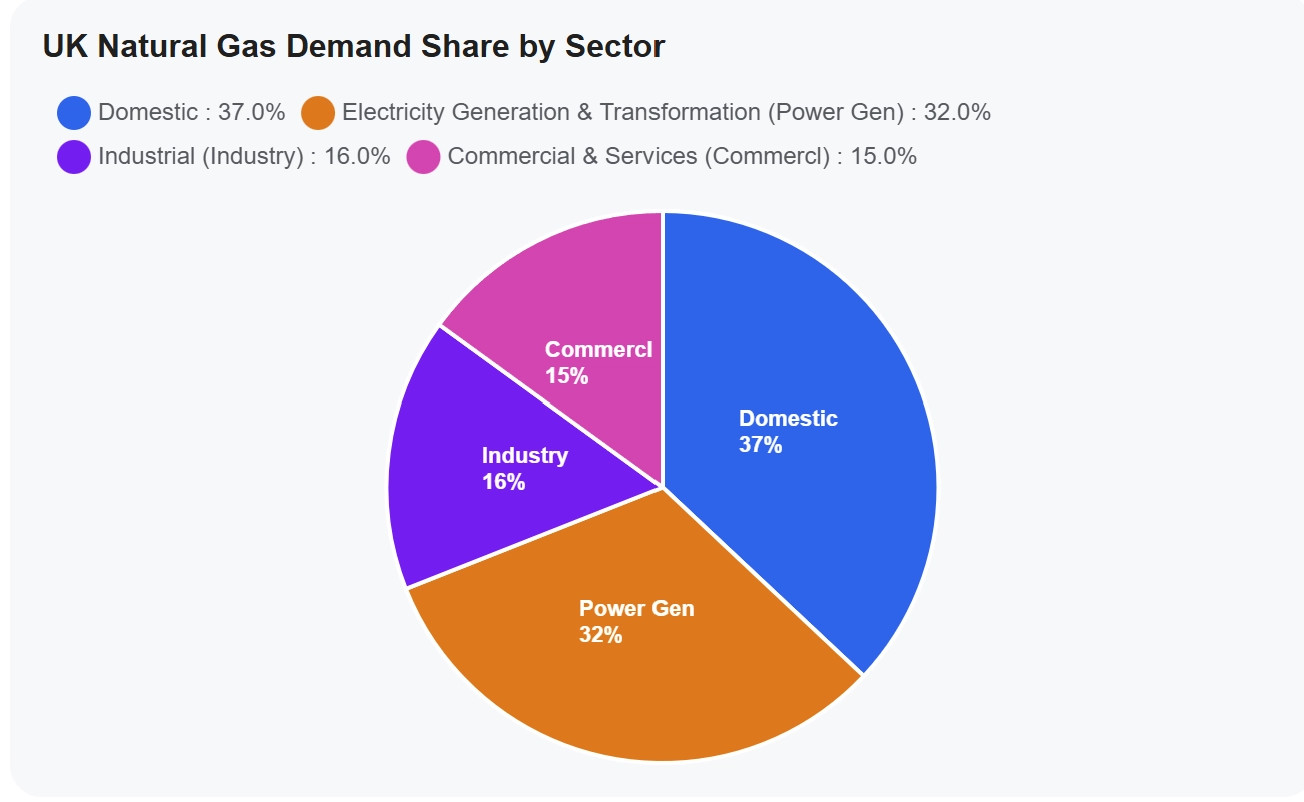
Chart 2 shows gas demand by sector: over half of it, domestic plus commercial, is effectively for heating spaces. We have made real progress in removing fossil fuels from electricity generation, and are now on a path that could see this could be completed, but not much in heating buildings.
Chart 2: UK natural gas demand by sector (DUKES 2026)
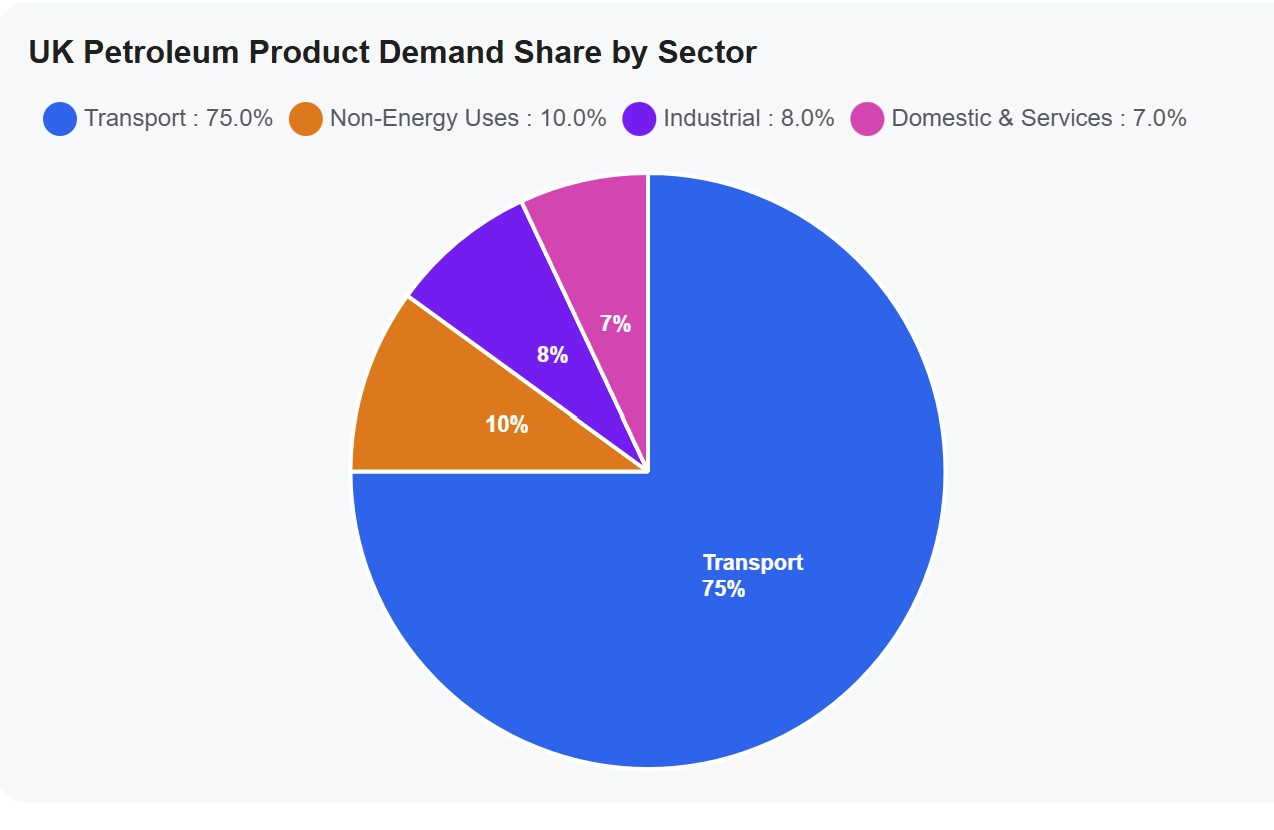
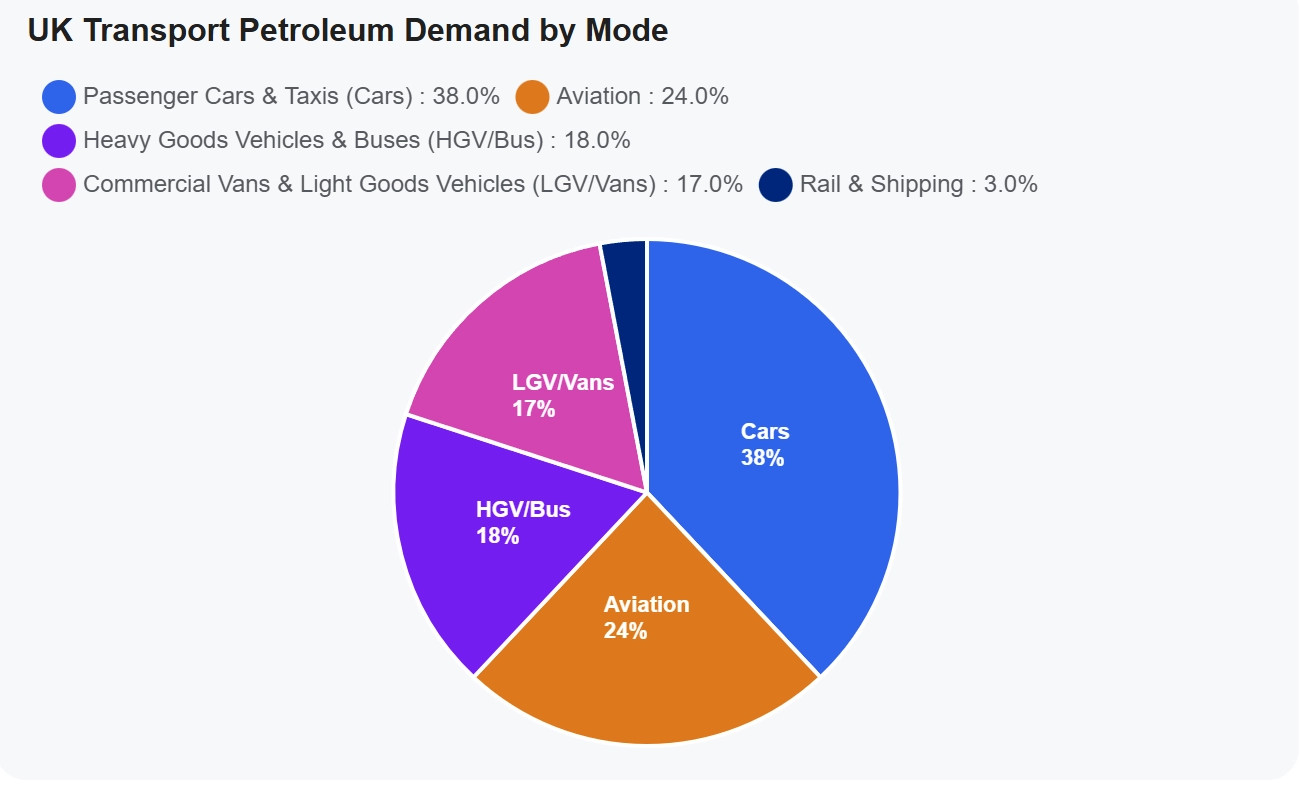
Charts 3 and 4 make the same point for petroleum: three-quarters of demand is transport, and within transport, 38% is cars and taxis, 24% aviation, 18% HGVs and buses, and 17% vans.
Chart 3: UK petroleum product demand by sector (ECUK 2025)
Chart 4: UK transport petroleum demand by mode (DUKES 2026)
That is where the difference lies. Reason (3) is by far the biggest of the three, and it is the one that decarbonising the grid does little to fix.
What doesn’t work: drilling for more
There is a live argument about whether the Government should license new North Sea oil and gas exploration. It does not solve the problem we’re trying to solve. If we increase domestic gas and oil production, most of it gets exported – the UK is a price taker in a global market, so more domestic supply doesn’t move the global price, and therefore doesn’t move what we pay at home. The Government gets tax revenue, and the balance of payments improves a little. but neither domestic energy costs nor resilience to price shocks changes.
Weaning ourselves off fossil fuels, properly
If the target is abundance and resilience rather than a 2050 number, the policy objectives change – our metrics should become annual reductions in fossil fuel use and reduction in energy price.
Focus on price. Every intervention should be judged first on whether it lowers the delivered cost of energy, because that’s what buys public consent for everything else.
Don’t put the cost of the transition on energy bills. The cost is a public good and therefore should not be on these bills, and plus it effectively penalises the current energy users for the benefit of future users.
Focus on where fossil fuel is used. In the short termthe two biggest areas are vehicles and heating spaces. The existing policy of 2030 ban on new petrol and diesel car sales is about as good a policy as we’re going to get. However, on heating buildings, the policy is not working. Our new framework identifies this as a national priority and should be treated as such. How we might go about this needs a separate article.
Combine energy policy with other levers. We are also facing a housing crisis, which is an opportunity because you can build new housing without central heating at all, rather than expensively retrofitting old housing stock.
Use the assets we’re already deploying. Electric vehicles can act as distributed battery storage: owners sell storage capacity back to the grid, which improves the economics of owning an EV and helps solve grid storage at the same time.
In the medium and longer term we need to concentrate on the hard-to-abate sectors with coordination problems. Cement is the obvious example: no individual firm can move first without being undercut, so the Government has to solve the coordination problem rather than just set a price.
The end of net zero, and the start of something that might work
The Net Stupid party want to abandon Net Zero for cultural reasons but not address real problems and risks. Even so, net zero is not the right organising principle for UK energy policy. I propose replace the target with a policy of cheap, abundant, resilient energy, pursued as a matter of national security. This would solve a lot of the problems caused by net zero – for example attracting energy intensive industries and boosting the economy through lower and stable energy costs. I’d guess that we end up doing more for the climate than net zero will deliver, while running a policy that everyone can buy into.
Rate this post
Leave a comment
Please login or register to leave a comment on this post.