Vince is a former City of London bond trader turned monetary policy advocate. A member of The 99% Organisation, he draws on twenty years of frontline experience in financial markets to challenge orthodox thinking on government finance and open up honest debate about the UK's fiscal choices.
Democracy is not for sale, but we keep letting them auction it off
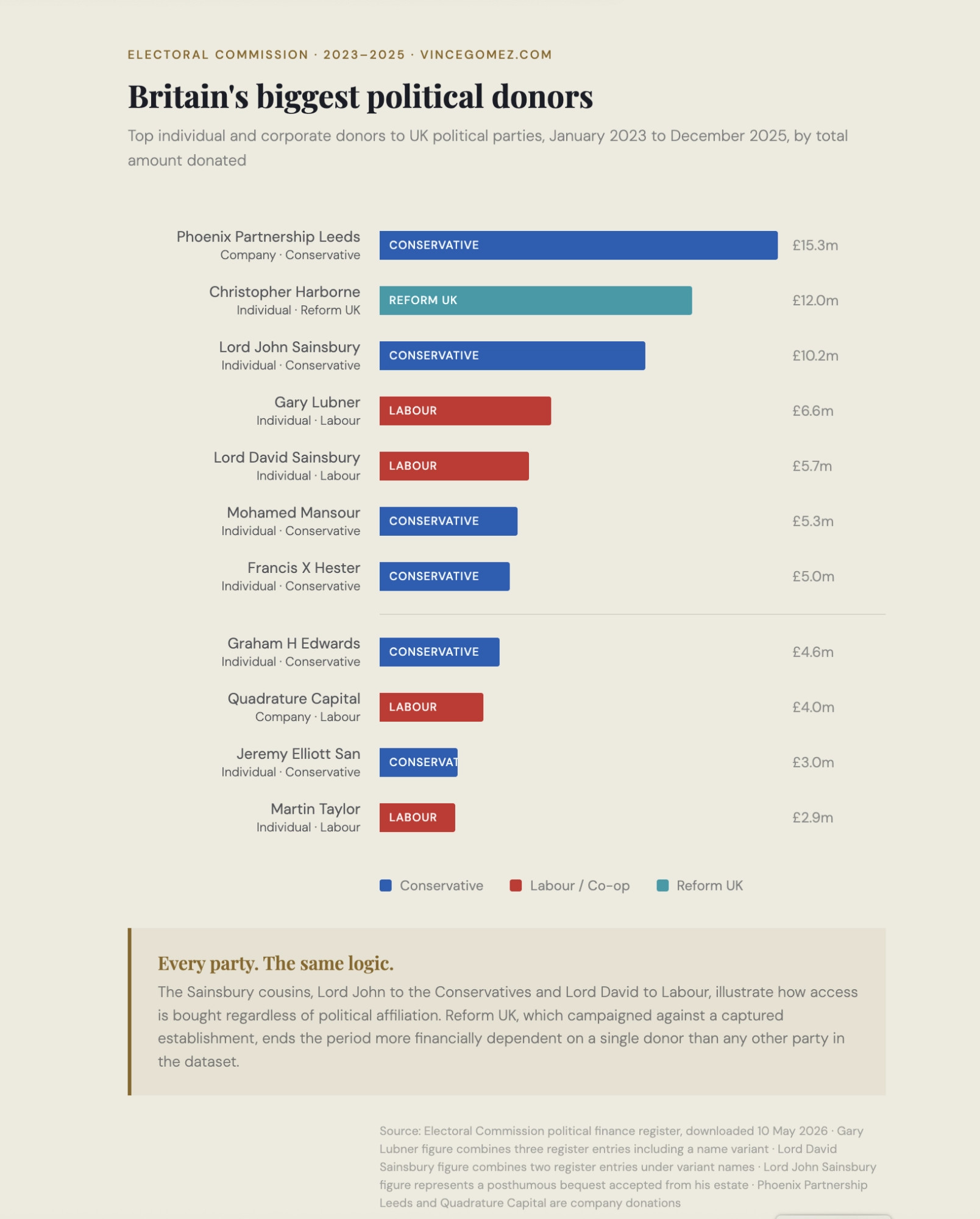
Mohamed Mansour, born in Egypt, gave more than £5 million to the Conservative Party in 2023.¹ Gary Lubner, born in South Africa, gave Labour and the Co-operative Party more than £6.6 million across three years.¹ Christopher Harborne donated £12 million to Reform UK in 2025 alone, including a £9 million single donation that was the largest gift by any living person in British political history.¹³ Between them, three individuals unknown to most voters spent more on shaping British politics than most British parties raise in a year. None of them stood for election.
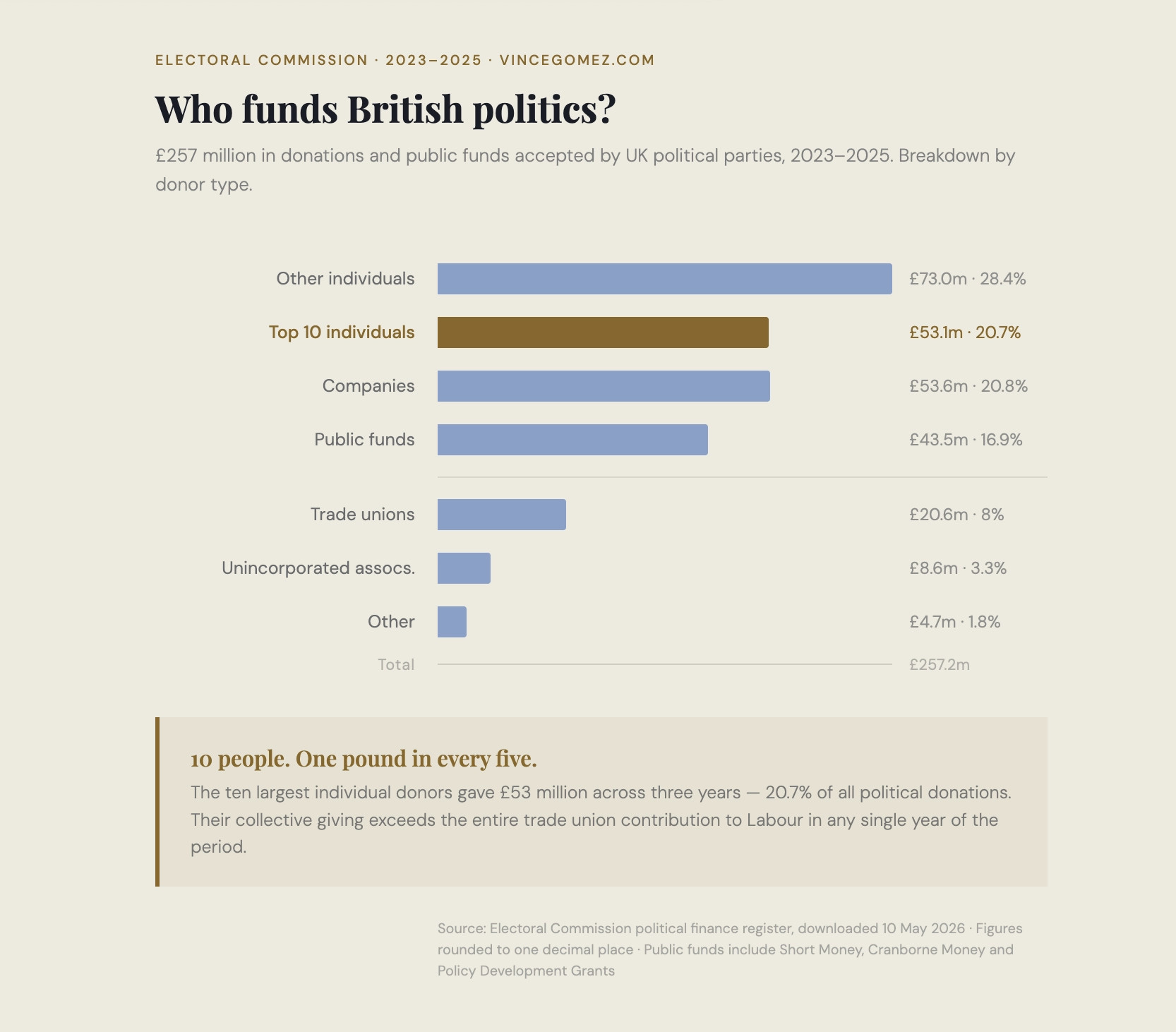
Between 2023 and 2025, British political parties accepted £257 million in private donations: £94 million in 2023, £98 million in the election year of 2024, and £65 million in 2025.¹ The post-election fall is predictable and accounted for. At its lowest, the underlying level of private money in British politics runs to tens of millions of pounds a year. £257 million across three years is the settled architecture of how British democracy is funded.
Total campaign spending in 2024 hit £94.5 million, the most expensive election in our history.³ Turnout was 60%, the second lowest since 1928.⁴ These numbers belong together. A democracy where the funding of political competition is controlled by a small class of wealthy donors is one in which most voters have already worked out they are not the intended audience.
The Committee on Standards in Public Life identified the mechanism in 1998, warning that large donations to political parties were widely suspected of being made "with some specific object in view."⁵ The committee argued that this suspicion alone, independent of whether undue influence was actually exercised, was corrosive to democratic legitimacy. Twenty-seven years later, the dependency has deepened and public trust has collapsed. Nothing has been legislated in response.
The mechanism of access
A donor who gives £5 million to a political party acquires proximity to decision-makers. Proximity generates access: when a minister's diary is being set or a policy paper circulated for comment, certain phone calls get returned and others do not. That asymmetry operates continuously, not just at election time, and no register of interests captures it.
The ten largest individual donors in the Electoral Commission register account for £53 million, one pound in every five donated across the full three-year period.¹
Lord John Sainsbury bequeathed £10.2 million to the Conservatives in his will; the party accepted the gift in 2023, making it the single largest individual donation in the dataset.¹ ¹⁹ His cousin, Lord David Sainsbury of Turville, gave £5.7 million to Labour across the same period, having previously donated £8 million to the Liberal Democrats in 2019, at the time the largest single political donation in British history.¹⁸ The same supermarket dynasty has now financed the Conservatives, Labour and the Liberal Democrats at scale. No agreement is required for this to constitute access: the Sainsbury name is known in every relevant ministerial office regardless of which party holds it.
Corporate money follows the same logic. The Phoenix Partnership, a Leeds-based company, gave the Conservatives £15.3 million across 2023 and 2024, more than the entire trade union contribution to Labour in any single year in the dataset.¹
In May 2024, five weeks before polling day, Quadrature Capital Limited gave Labour £4 million, the largest single donation in the party's history.¹⁰ᵃ A London-based hedge fund with a Cayman Islands-incorporated parent company, Quadrature manages a share portfolio worth approximately $6 billion, with holdings spanning fossil fuel companies, private health firms and arms manufacturers.¹⁰ᵃ ²⁰ The donation was made in the narrow window between Rishi Sunak calling the election and the start of the pre-poll reporting period; it was not published until more than two months after Labour won.¹⁰ᵃ Quadrature described the gift as a values-based contribution made in support of climate policy rather than a conventional political donation. Transparency International UK warned that donations at this scale raise questions about "in whose interest politicians are working."¹⁰ᵃ
Corporate donations to UK parties rose from £14 million in 2023 to £30.5 million in 2024, as businesses positioned themselves ahead of a change of power.¹ Trade unions gave Labour £9.8 million in the election year: UNISON contributed £2.7 million, USDAW £2.2 million and GMB £2 million.¹ In 2023, two individual donors, Gary Lubner and Lord David Sainsbury, gave Labour more than all its trade unions combined: £7.6 million against £5.9 million from the entire union movement.¹⁹ The instinct to frame this debate as union money against corporate money suits both sides. The Electoral Commission data points to a more accurate description: a competition between different concentrations of private money, each seeking proximity to power, none of it answerable to the electorate.
Reform UK fought the 2024 election as the insurgent alternative to an establishment it argued had been captured by vested interests. Christopher Harborne has given more than £22 million to the party since 2019, roughly two-thirds of all funding Reform has received since its foundation.¹³ᵃ A British billionaire who has lived in Thailand for two decades under the Thai name Chakrit Sakunkrit, Harborne holds a 12% stake in Tether, the world's most widely used cryptocurrency stablecoin, and began his major donations to Farage's Brexit Party in 2019, the same year the New York attorney general launched a fraud investigation into the company.¹³ᵃ Tether's stablecoins have been used for illicit money transfers by organised crime networks and Russian sanctions-busters; UK National Crime Agency investigators have linked them to a money-laundering scheme serving the Russian war effort in Ukraine.¹³ᵃ Harborne's lawyers state that neither he nor Tether bears responsibility for criminal uses of the stablecoin by unassociated third parties.¹³ᵃ
The £9 million he gave in August 2025 was the largest single donation by any living person in British political history.¹³ A separate personal gift of £5 million to Farage in early 2024 was not initially declared; the Electoral Commission is investigating the non-disclosure, and the matter has been referred to the parliamentary commissioner for standards.¹¹ Since accepting the donations, Farage has become an active public advocate for cryptocurrency: Reform became the first UK party to accept crypto donations and drafted legislation reducing taxes on crypto profits.¹³ᵃ Farage has told the media that Tether will soon be worth $500 billion and lobbied the Bank of England on its behalf; his stated position is that Harborne has sought no return on his investment.¹³ᵃ Emma Nicholson, a Conservative peer who knows both men, reached a different conclusion: "I think Nigel is mad to accept his money."¹³ᵃ
Labour's total income in 2024 was £90.7 million. The Conservatives took in £50.2 million.¹⁰ The machinery of democratic competition in this country has become a fundraising operation that occasionally also does politics.
Public trust
Confidence in the transparency of political finance has fallen from 30% in 2014 to 15% in 2024.⁷ Only 14% of people say they trust politicians.⁸ More than half, 54%, believe elected representatives do not care about people like them.⁸ Electoral Commission research finds that perceptions of political finance consistently drive decisions not to vote.⁴ These figures describe a measurable collapse in democratic legitimacy. The money problem sits near the centre of that collapse.
The wrong remedy
Jackie Killeen, the Electoral Commission's Director of Electoral Administration and Regulation, acknowledged in March 2026 that "there are parts of the system that need strengthening."⁹ The Commission has welcomed the government's Representation of the People Bill as a vehicle for tightening donation controls. The reforms it targets address three familiar vulnerabilities: company donations funded from overseas income, parties failing to verify the source of large gifts, and unincorporated associations whose ultimate funders face no permissibility checks at all.
These are reasonable demands. The difficulty is that each one accepts the premise that private money in British politics is structurally fine, provided it comes from British sources. The distortion traced earlier in this piece, donor proximity generating access, access creating asymmetry in whose calls get returned, operates through the same mechanism whether the money originates in Cairo, Johannesburg or Guildford. A £5 million donation from a UK-domiciled individual warps a party's incentive structure as thoroughly as one from overseas. What those reforms address is the passport of private money. The private money itself remains, and with it the fundamental problem: democratic representation in this country carries a price that most of the electorate cannot afford to pay.
The cost of replacement
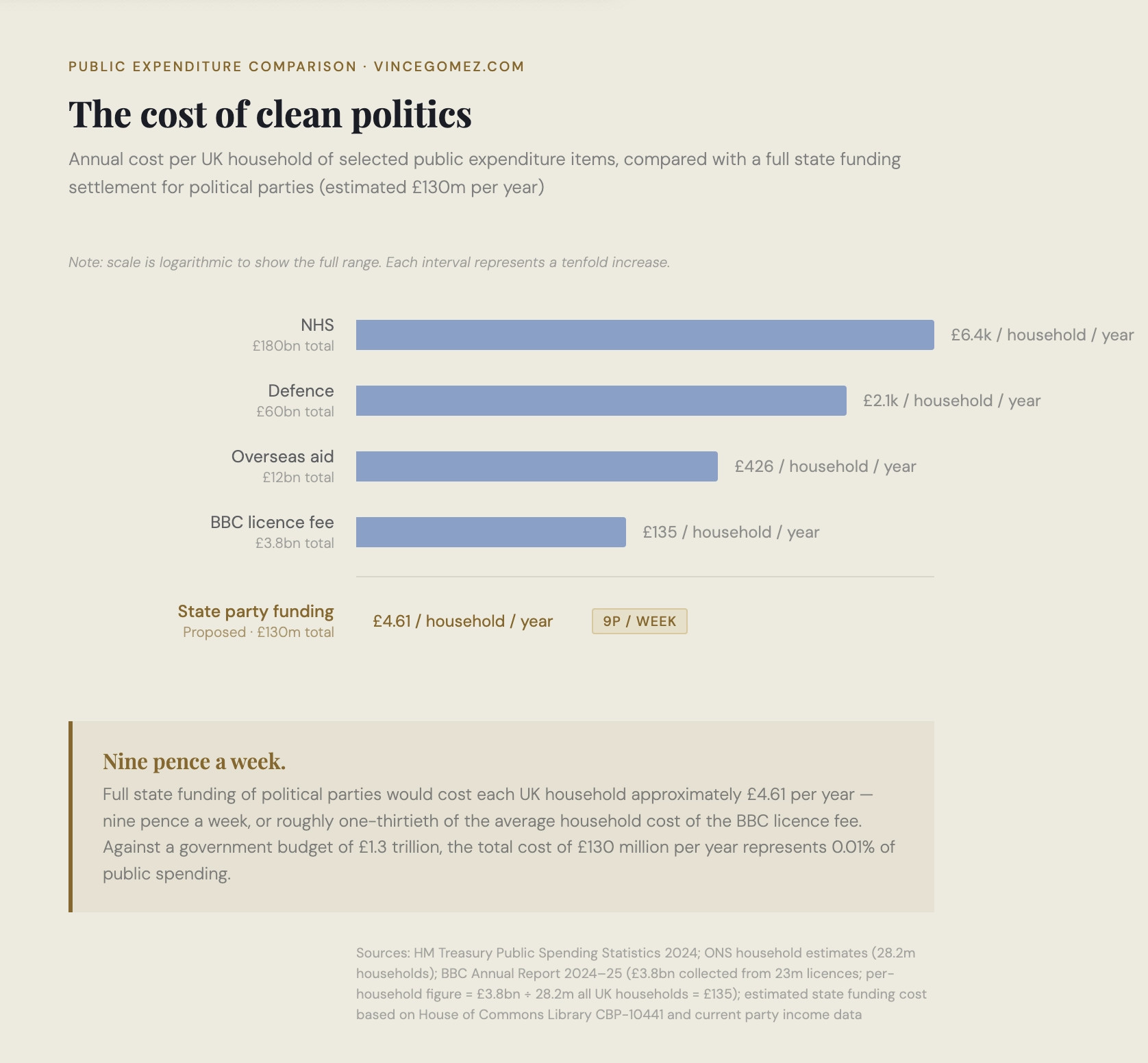
Total annual income and expenditure across the sixteen UK parties filing above the £250,000 threshold ran to roughly £90 million in 2024.¹⁰ A state settlement replacing private donations above a nominal threshold, covering party operations and a regulated campaign allowance, would cost between £100 and £150 million per year on average. Against a government budget of £1.3 trillion, that is 0.01% of total public spending.
The UK already distributes approximately £20–25 million annually through Short Money, Cranborne Money and Policy Development Grants: public subsidies to political parties that nobody campaigns to abolish.¹⁰ Full replacement of private funding would require roughly five times that sum, at a cost of around £4.60 per household per year.
Seventy per cent of countries worldwide use some form of direct state funding for political parties.¹⁰ Among European democracies, the UK provides one of the lowest proportions of state funding relative to total party income; only Italy, Malta and Switzerland are similarly dependent on voluntary sources. Between 2002 and 2017, only 9% of UK party income came from state sources, one of the lowest ratios in Europe.¹⁰
Three objections
Taxpayers, the argument runs, should not be compelled to fund parties they oppose. Short Money, Cranborne Money and Policy Development Grants already distribute public funds directly to political parties.¹⁰ The principle is conceded in British law. The live question is whether to extend it in a way that ends the distortion of private money, or to preserve a system that routes public subsidy to established parties while letting private money fund their campaigns with conditions attached.
A per-vote formula tied to the previous general election, with a minimum eligibility threshold and distribution managed by the Electoral Commission, is the most defensible allocation mechanism. Fifty pence per vote was the Committee on Standards in Public Life's proposal in 2011, costed at an additional £23 million per year in public spending.¹¹ᵃ The architecture is understood. Parliament has never built it.
In November 2011, when the Committee on Standards in Public Life made that recommendation, Nick Clegg blocked it on grounds of cost, arguing it would "not be right to ask our hard-pressed taxpayers to pay more" to political parties during a period of public spending cuts.²⁴ The annual cost of the proposal was £23 million. In the decade that followed, the Bank of England deployed a total of £895 billion in quantitative easing: a sum roughly 38,000 times larger than the annual cost of the reform Clegg had shelved.²⁵ The affordability argument has been deployed against every subsequent proposal for state party funding; its persuasiveness depends entirely on public ignorance of what the state is actually capable of spending when it chooses to.
The weightiest objection is structural: the parties that would have to legislate this reform benefit from the existing arrangement. The Hayden Phillips Review of 2007 collapsed without agreement, Committee on Standards in Public Life recommendations in 2011 were shelved when the coalition government cited austerity, and cross-party talks in 2013 ended without consensus.¹⁰ A parliament that cannot reform its funding model has already been shaped by it.
None of this means state funding eliminates political corruption: research on whether public subsidy reduces corrupt behaviour produces mixed findings, and the case for universal effectiveness is weaker than advocates sometimes claim.¹⁰ None of this means allocation is straightforward; a poorly designed eligibility formula can protect incumbents as effectively as any donor relationship. The current system is measurably failing and the failure is worsening, at a public cost of doing nothing that is paid in legitimacy rather than money.
A 2024 study published inParty Politics found that public support for state funding rises sharply when the argument centres on ending donor influence rather than financing politicians.¹² That reframing is accurate.
The American example
The United States offers a 15-year preview of one possible trajectory. The Supreme Court's Citizens United decision of 2010 removed limits on corporate and union spending in federal elections. The Court premised the ruling on the assumption that all newly permitted spending would be transparent. In 2024, $1.9 billion in dark money poured into federal elections from groups not required to disclose their donors, a record that doubled the previous high set four years earlier and almost certainly an undercount of the true total.²² Billionaire political spending has risen 160-fold since Citizens United.²¹ In the 2024 cycle, 100 billionaire families contributed $2.6 billion to federal elections, one dollar in every six spent overall.²¹ Elon Musk contributed $278 million, principally in support of Donald Trump's presidential campaign; he was subsequently appointed to lead the body tasked with overseeing cuts to federal spending.²¹ The total cost of the 2024 federal election cycle reached $15.9 billion. Converted to sterling and spread across American households, that amounts to approximately £95 per household, against the £3.35 per household that Britain spent at its most expensive general election. The ratio is 28.5 to one.²³
Britain's spending limits and disclosure requirements create friction that the US system abandoned. The direction of travel visible in this piece's data points the same way: donation concentration is rising, and mega-donors now account for an increasing share of party income. The proposed Representation of the People Bill tightens the rules on who can give, not how much anyone can give. Citizens United was the culmination of two decades of incremental legal change. Each step seemed modest at the time. Parliament currently has a working majority, a reform bill in progress and a public whose confidence in political finance has halved in a decade. The choice of whether to use that position to structurally limit private money, or to proceed with incremental adjustments that leave the architecture intact, will determine which trajectory British democracy follows.
Mansour, Lubner and Harborne did not stand for election. The question is what their money stood for instead.
Sources
1. Electoral Commission political finance register, downloaded 10 May 2026https://search.electoralcommission.org.uk/(11,238-row dataset, January 2023 – December 2025: three-year total £257.2m; annual totals £94m/£98m/£65m; donor totals — Lord John Sainsbury estate £10.2m, Lord David Sainsbury £5.7m, Gary Lubner £6.6m, Mohamed Mansour £5.26m; Phoenix Partnership Leeds £15.3m; corporate donations £14m/£30.5m by year; trade union totals — 2023 £5.9m; 2024 UNISON £2.7m, USDAW £2.2m, GMB £2m, total £9.8m; top 10 individuals = £53m = 20.7% of all donations; party income 2024 — Labour £90.7m, Conservatives £50.2m)
10. House of Commons Library,Political financing: Donations, loans and state funding, CBP-10441 (December 2025)https://commonslibrary.parliament.uk/research-briefings/cbp-10441/(Party income 2024 Table 1 p.18; Short Money/Cranborne/PDGs pp.27–30; 9% state subsidy p.12; 70% of countries p.7; UK exceptionalism p.27; CSPL/Hayden Phillips history pp.44–49; mixed evidence on corruption pp.35–36)
13a. Tom Burgis, Rowena Mason and Henry Dyer, 'Who is Christopher Harborne, the mystery billionaire bankrolling Reform?',The Guardian, 25 April 2026https://www.theguardian.com/politics/2026/apr/25/christopher-harborne-mystery-billionaire-bankrolling-reform-uk-nigel-farage(£22m+ total; two-thirds of Reform funding; Thai name Chakrit Sakunkrit; 12% Tether stake; NY attorney general investigation April 2019; NCA money-laundering link to Russian war effort; lawyers' denial; Reform and crypto donations; crypto tax legislation; Farage lobbying Bank of England; Farage $500bn prediction; Nicholson quote)
20. Companies House, MR01 filing for Quadrature Capital Limited, company number 09516131, filed 11 November 2024(Quadrature Capital Limited confirmed as incorporated in England and Wales, 122 Leadenhall Street, London EC3V 4AB. Quadrature Technology Limited, company number 401837, is the Cayman Islands-incorporated parent entity)
21. Americans for Tax Fairness,Billionaires Buying Elections: They've Come to Collect (May 2025)https://americansfortaxfairness.org/billionaires-buying-elections-theyve-come-to-collect/(100 billionaire families = $2.6bn = one in every six dollars; 160-fold increase since Citizens United; Elon Musk $278m principally supporting Trump; Musk subsequently appointed to lead DOGE)
24. Nick Clegg, HC Deb 23 November 2011, c25WS Cited in: House of Commons Library, CBP-10441, p.48https://researchbriefings.files.parliament.uk/documents/CBP-10441/CBP-10441.pdf(Clegg blocking CSPL recommendation on grounds of cost; quote: "not be right to ask our hard-pressed taxpayers to pay more to political parties")